
Short story of chocolate and health: benefits or hype?
Chocolate sits at a fascinating crossroads between pleasure, culture, medicine, and commerce. Few foods have been celebrated, demonised, medicalised, and reinvented quite so many times.
1. Chocolate today: market growth and health perceptions
The global chocolate market is currently valued at around USD 141 billion, according to Statista, making it one of the world’s most lucrative commodities. Driven largely by health-focused consumer choices, it is projected to reach USD 184.69 billion by 2033, according to Grand View Research.
Much of this growth is fuelled by the perceived health benefits of high-cocoa chocolate, particularly varieties containing 75–80% cocoa solids or more, which are increasingly marketed as functional foods.
There is no doubt that cocoa itself offers genuine health benefits, supported by a growing body of robust scientific research. Yet chocolate is also a commodity — and has been treated as such for centuries. Commodity prices for raw cocoa beans have behaved very differently over time and remain highly sensitive to climate and geopolitics. For example, cocoa futures surged to nearly US$12,000 per metric tonne in late 2024 before declining significantly through 2025, at times falling to around US$5,800–US$6,300 per tonne according to data from the International Cocoa Organization — which calculates daily average prices from futures markets in London and New York. Despite this dramatic volatility in the underlying commodity, consumer demand for chocolate and retail product pricing remain comparatively stable, because the part of the market concerned with finished products is far less directly exposed to short-term swings in raw material costs. Long before it reached Europe, cacao beans were used as a form of currency by the ancient Mayans and Aztecs. When chocolate was first introduced to Europe, it functioned not only as a supposed health remedy, but also as a marker of social status, much as sugar, spices, coffee, and tea had done earlier. Sugar, for example, entered Europe via Crusaders in the 11th century, despite sugar cane having already been cultivated by Arab populations in Sicily, Cyprus, and Spain as early as the 7th–8th centuries.
2. Pre-Columbian origins: spiritual, ritual, and medicinal uses
Long before the Spanish brought this “mystical superfood” to Europe, cacao had been cultivated and revered for centuries by the ancient Mayans of Mesoamerica (modern Central America and southern Mexico) and by the Aztecs as early as 600 BC.
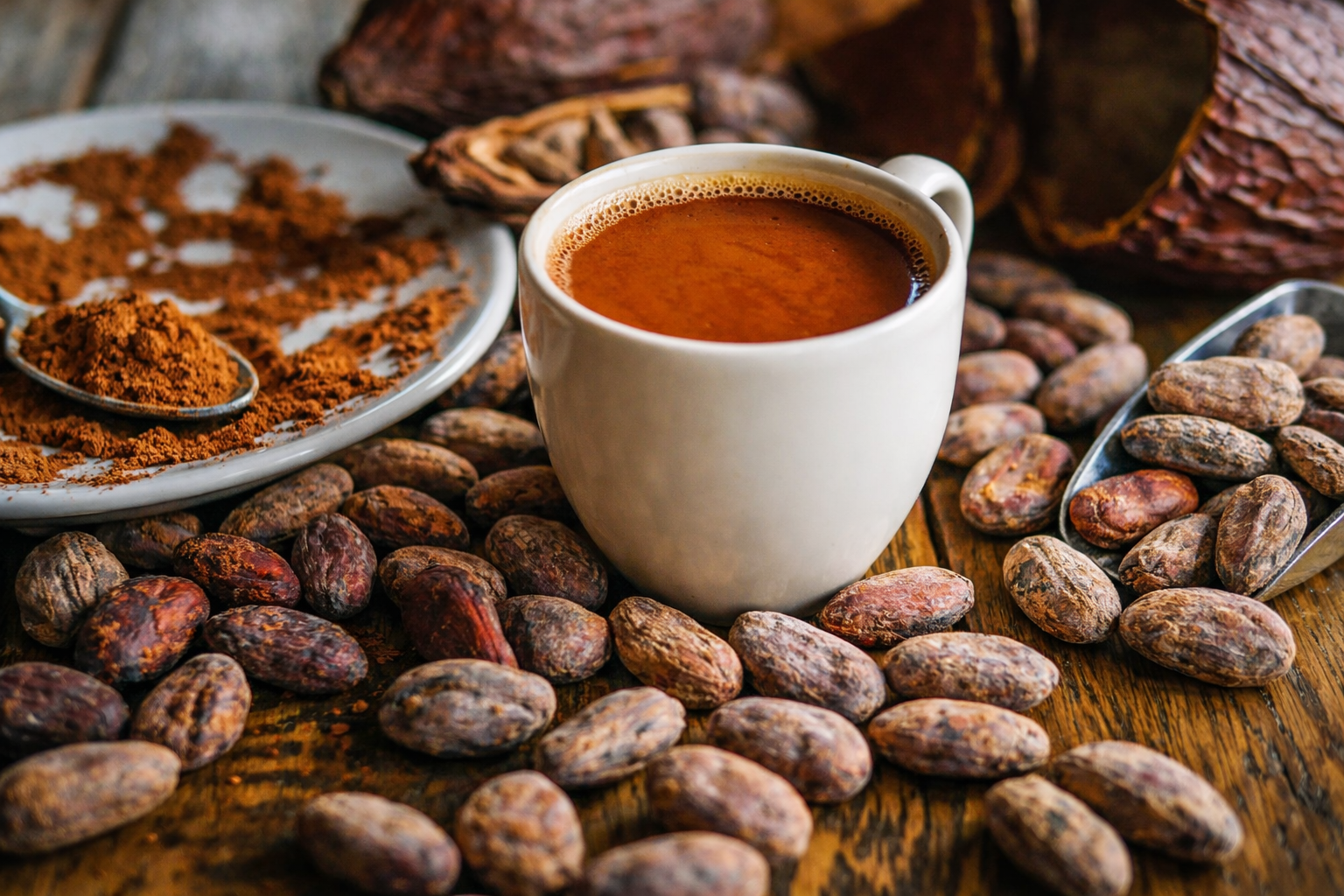
They consumed a bitter, frothy drink made from dried, ground cocoa beans mixed with hot water and often flavoured with chilli. This beverage was believed to strengthen warriors, revitalise the body, and combat fatigue.
Scientific literature suggests that cacao consumption may date back even further—to 1600–1500 BC, during the Olmec civilisation, as indicated by Powis et al. At this time, cacao was primarily consumed as a hot drink for religious purposes. Archaeological evidence suggests cocoa drinks and cocoa beans were placed in tombs, as it was believed they could energise the soul of the deceased and aid their transition to the supernatural world. This deep spiritual symbolism helped cement cacao’s central role in Olmec society.
3. Arrival in Europe: Spain and early medicalisation
Cacao first arrived in Europe in 1527, brought by the Spanish explorer Hernán Cortés following Spain’s discovery of the New World in the 16th century. Interest in chocolate spread gradually across European royal courts and elite households, where it was initially introduced as a panacea and dispensed by pharmacists.
By 1544, chocolate was being served at the Spanish court. The drink was intensely bitter, but innovations such as the addition of sugar and vanilla transformed it, giving rise to a new culinary fashion. At the time, chocolate was a luxury accessible only to the wealthy—comparable to rare delicacies today, such as caviar (which can only be called caviar if it comes from sturgeon), white truffle, or Kobe beef.
4. Diffusion across European courts: Italy, France, and beyond
Although Switzerland is now widely associated with high-quality chocolate—alongside its meticulously crafted watches—it was not the first country to embrace chocolate after Spain.
From the Spanish court, the fashion for drinking chocolate reached Italy in 1559, when Emanuele Filiberto, Duke of Savoy, reportedly offered steaming cups of chocolate to the citizens of Turin to celebrate the relocation of the ducal capital from Chambéry to Turin. This symbolic act introduced chocolate more widely in Italy and paved the way for Turin’s enduring chocolate innovations, including Bicerin and Gianduiotto.
Chocolate reached the French royal court in 1615, when Anne of Austria, daughter of King Philip III of Spain, married King Louis XIII of France and brought with her the Spanish custom of drinking chocolate. From there, it spread to other European royal courts.
In Switzerland, chocolate appeared comparatively later, with early references dating to 1697, when figures such as Zurich’s mayor, Heinrich Escher, are recorded as consuming this expensive and bitter drink. However, Switzerland’s rise to world-renowned chocolate status owes much to Italian migration. Italian chocolatiers brought with them well-established expertise in chocolate-making — from cacao grinding to confectionery techniques — and contributed to the foundations of Switzerland’s most influential chocolate businesses.
5. Italian innovation and craftsmanship
Bicerin—a layered drink of hot coffee, cacao, and milk cream—was developed in Turin in the 1700s. Later came Gianduiotto, invented in 1865 by Michele Prochet, which combined cacao with hazelnuts from Piedmont’s Langhe region. Made using the prized Tonda Gentile hazelnut, it became the world’s first individually wrapped chocolate.
These innovations were made possible by the skilled maestri of Turin, who from the 17th century onwards experimented with new techniques to blend cacao, vanilla, water, and sugar into a smooth, malleable paste.
6. Chocolate and medicine: 17th–18th century debates
The 17th and 18th centuries saw vigorous scientific debate about chocolate’s medical value. Spanish physicians such as Bartolomeo Marradon and Henry Stubbe, physician to Charles II of Great Britain, played prominent roles in discussions that reached their peak in Florence.
Scholars examined chocolate’s components in detail, believing that understanding its properties was essential for preparing the most appropriate cacao-based remedy for individual patients. In 1662, the Roman physician Paolo Zacchia prescribed chocolate for hypochondria, echoing Stubbe’s views.
Not all physicians were convinced. Critics argued that chocolate could cause serious health problems. In Florence, the debate intensified, culminating in the publication of four pamphlets in 1728. Between 1684 and 1736, chocolate’s medical use was even the subject of academic theses at the Medical Faculty of Paris.
7. Florence, the Medici court, and medical luxury
A 19th-century writer claimed that the first person to prepare and sell chocolate in Florence as a heart remedy was an apothecary named Tozzetti, during the reign of Grand Duke Ferdinando I de’ Medici.
The Medici court was a unique environment where scientific rigour coexisted with indulgence. Francesco Redi, physician and scientist at court, embodied this balance. While he expressed scepticism about chocolate in his poem Bacco in Toscana, his name is also associated with the invention of a jasmine-scented chocolate.
This so-called “Grand Duke’s recipe” was patented, kept secret until 1712, and could be tasted only in Florence—exclusively at court or in the homes of the highest nobility. Historical accounts even suggest that Florentine ladies were treated for excessive blood loss through the continued use of chocolate as a desiccant and astringent medicament.
8. Systematising chocolate’s medical claims
The first dissertation resembling a modern “systematic review” was produced by Giovan Battista Anfossi, who examined writings by Spanish, English, and Italian physicians and pharmacists. He identified which therapeutic claims were repeatedly associated with chocolate and which were less substantiated, adding his own observations—including the topical use of cocoa butter for haemorrhoids.
Further claims followed. Carl von Linné (Linnaeus) described chocolate as both nourishment and medicine, recommending it for conditions such as weight loss due to lung or muscle disease, hypochondria, and haemorrhoids. He also described it as an excellent aphrodisiac.
The century closed with Antonio Lavedan, who proclaimed chocolate a universal medicine, crediting it with warming the body, stimulating the heart, improving digestion, increasing virility, slowing greying hair, and even prolonging life.
9. From medicine to pleasure
As dietetics gradually separated from medicine, chocolate lost its medicinal status and became increasingly associated with pleasure—and, eventually, with health concerns. Yet interest in its nutritional potential never disappeared.
Throughout history, chocolate has been used to treat a wide range of ailments. Modern research has begun to confirm some of these traditional claims, although recognition of chocolate’s benefits has always been shaped by religious, medical, and cultural debates.
10. A national perspective: chocolate in Poland
Chocolate reached Poland in 1665, during the reign of Jan III Sobieski, who first encountered it through his French wife, Marie Casimire de La Grange d’Arquien. As elsewhere in Europe, chocolate initially remained confined to royal and aristocratic circles.
Under Stanisław Poniatowski, chocolate became part of elaborate court cuisine, although it remained a luxury. It was consumed as a hot, flavoured drink—made with water, cocoa, chilli or cinnamon, vanilla, sugar, and cocoa butter—and enjoyed using specially designed cups, pots, and spoons.
Chocolate became accessible to the wider public in the 19th century, largely thanks to Wedel, founded in Warsaw in 1851 by Karol Wedel. By the 1930s, Wedel was internationally recognised, with shops in London, Paris, and Japan. The company’s fortunes changed after the Second World War, when it was nationalised under the communist regime and later sold to PepsiCo in 1991, leading to a decline in quality.
11. Chocolate houses and early public consumption
Before chocolate became a confectionery product, it was primarily consumed as a drink and sold in pharmacies as a strengthening and mood-enhancing remedy.
Europe’s first chocolate house opened in London in 1657, followed by Bremen in 1674. In Florence, the renowned Santa Maria Novella pharmacy began serving hot chocolate in gold or silver bowls in 1751.
12. Industrialisation and modern chocolate
The first modern chocolate bar appeared in 1847, created by British chocolatier J. S. Fry & Sons. This followed a major technological breakthrough in 1828, when Dutch chemist Coenraad van Houten invented the cocoa press, separating cocoa butter from the bean and making cocoa more affordable.
Later industrial changes—including the addition of milk and cheaper substitutes—contributed to chocolate’s 20th-century reputation as a high-fat, high-calorie food associated with obesity and dental problems.
13. Chocolate, war, and cultural mythology
One striking anecdote from the Second World War tells of a Nazi plot to assassinate Winston Churchill using an explosive chocolate bar—an episode that helped popularise the phrase “death by chocolate”.
Today, chocolate is more widely available than ever, particularly in affluent societies, including Europe and the Gulf states.
14. Beauty trends, nutrition, and concluding reflections
In the early 2000s, chocolate experienced a brief renaissance in the beauty industry, appearing in face masks, body scrubs, and spa treatments. As with many such trends, it proved short-lived.
As a dietitian, I would argue that beauty truly starts from within. Topical treatments have limited impact if the body is under internal strain—for example, due to poor diet or compromised gut health. Increasingly, science recognises the importance of the gut–brain–skin axis.
While ancient cultures believed in the topical healing powers of chocolate, modern evidence suggests its benefits are far more convincing when chocolate is consumed as part of the diet—particularly when it contains a high proportion of cocoa solids.
To learn more, read my other article, where I explore what chocolate provides as an alimentary agent.
